
Developer Resource Vault
An offline catalogue of free developer resources that refuses to guess.
A searchable local catalogue of free APIs, datasets, SDKs, models and self-hosted tools, where every entry records how well its claims were actually verified.
Worth knowing
A developer tool rather than a consumer product. It is run locally from source and is not distributed.
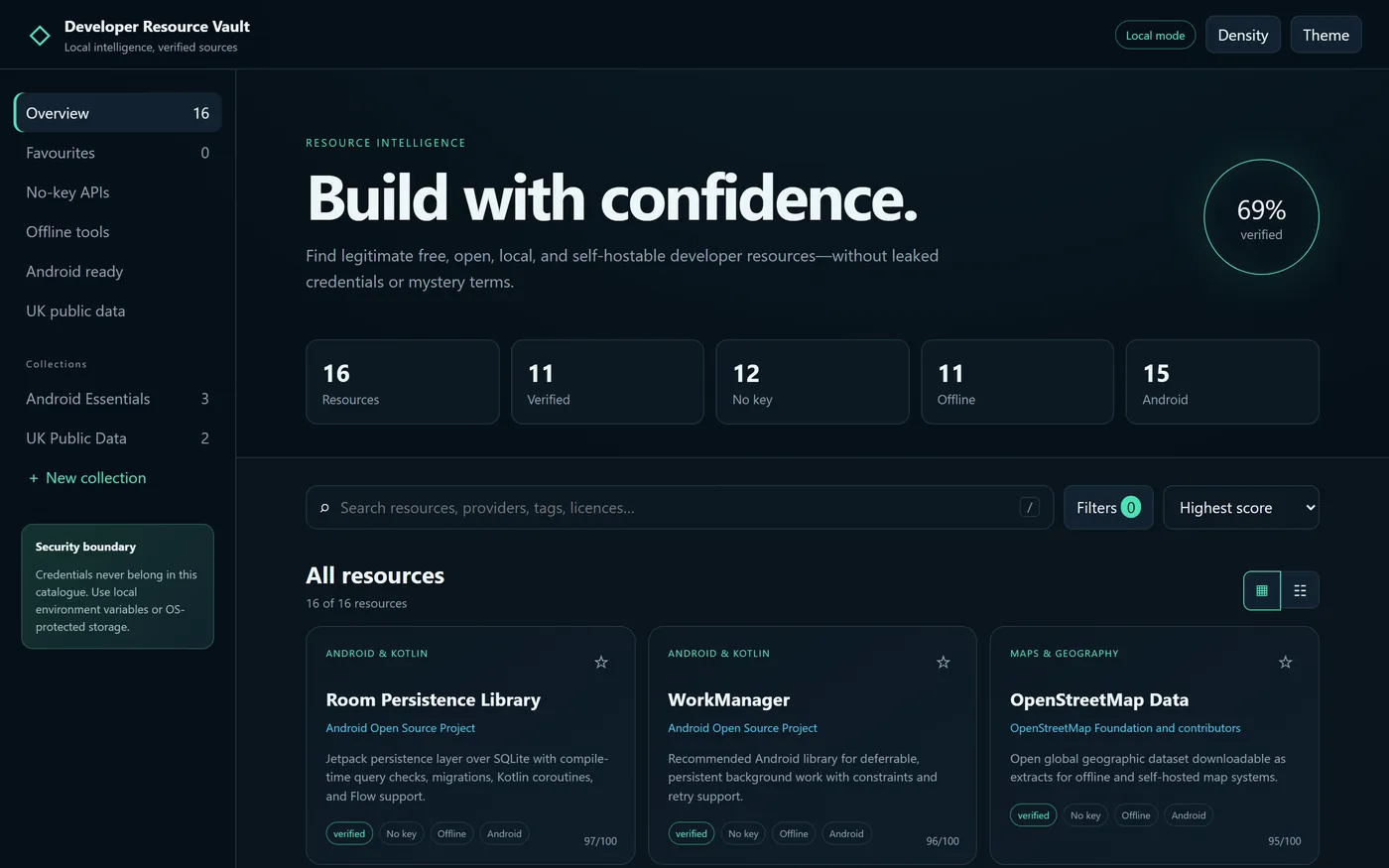
Screenshots
Captured from version 1.0.0 running locally, with its own built-in catalogue.
Showing screenshot 1 of 4
What Resource Vault is
The Developer Resource Vault is an internal tool that solves a specific, recurring problem: finding a genuinely free, genuinely appropriate API or dataset without trawling link-farm listicles. It is an offline-first, searchable catalogue of APIs, datasets, SDKs, models, assets, libraries and self-hosted tools, served by a dependency-free Node server on the local machine. Its most useful property is epistemic rather than technical: every entry carries a trust level — verified, partial or unknown — and the project's rule is that `unknown` is always preferred to a fabricated quota, licence or capability. Link, licence and duplicate checks run as scripts using only public URLs and no credentials. A separate check reports whether a local environment variable exists, masking values and making no API calls. Favourites, collections, notes and theme stay in the browser profile and are never written back into the catalogue.
What it does
- Searchable offline catalogue of free APIs, datasets, SDKs, models, assets and self-hosted tools
- Per-entry trust levels — verified, partial or unknown — with evidence URLs and check dates
- "Unknown" is preferred to a fabricated quota, licence or capability
- Link, licence and duplicate checks that use only public URLs and no credentials
- A key check that reports presence only, masking every value
- Zero runtime dependencies — Node and nothing else
A catalogue that admits what it does not know
Most resource lists quietly imply that every entry is current and every limit is accurate. This one records, per entry, whether the claims were checked against evidence URLs and on what date — and treats "unknown" as a perfectly good answer. That makes it slower to fill and considerably more useful to trust.
Deliberate constraints
The constraints are the design.
Not a credential harvester
Only official signup routes, public access, open data and local or self-hosted resources are listed.
No runtime dependencies
The server uses Node's standard library alone, so there is no supply chain to audit.
Checks without credentials
Link and licence checks use public URLs only; the key check never performs an API call.
Personal state stays personal
Favourites and notes live in the browser profile, never in the shared catalogue file.
Getting Resource Vault
Developer Resource Vault 1.0.0 is finished and feature-complete. There is no store listing yet, so there is no download button here — one will appear by itself the moment a real link exists. This site never publishes a placeholder download.
At a glance
- Status
- Released
- Version
- 1.0.0
- Runs on
- Web, Desktop
- Offline use
- Works offline
- Last updated
Privacy
Runs locally on your own machine. It stores no credentials, performs no API calls during verification, and keeps personal notes in the browser profile rather than in the catalogue.
Permissions
This project requires no special permissions.
Technical details
Technical details
Built with
How it is put together
- A searchable offline catalogue of free APIs, datasets, SDKs and self-hosted tools, served by a dependency-free Node server.
- Every entry records a trust level — verified, partial or unknown — and `unknown` is preferred to a fabricated claim.
- Link, licence and duplicate checks run as scripts; the key check only reports whether a local variable exists, never its value.
Development workflow
Built through Codex.
Timeline
- Version 1.0.0
Catalogue, verification scripts and export prompts complete.
Accessibility in the app
- Theme and density preferences kept per browser profile
- Works entirely without a network connection